General technical page
X-Ray Diffraction (XRD) Analysis
Discuss an XRD Investigation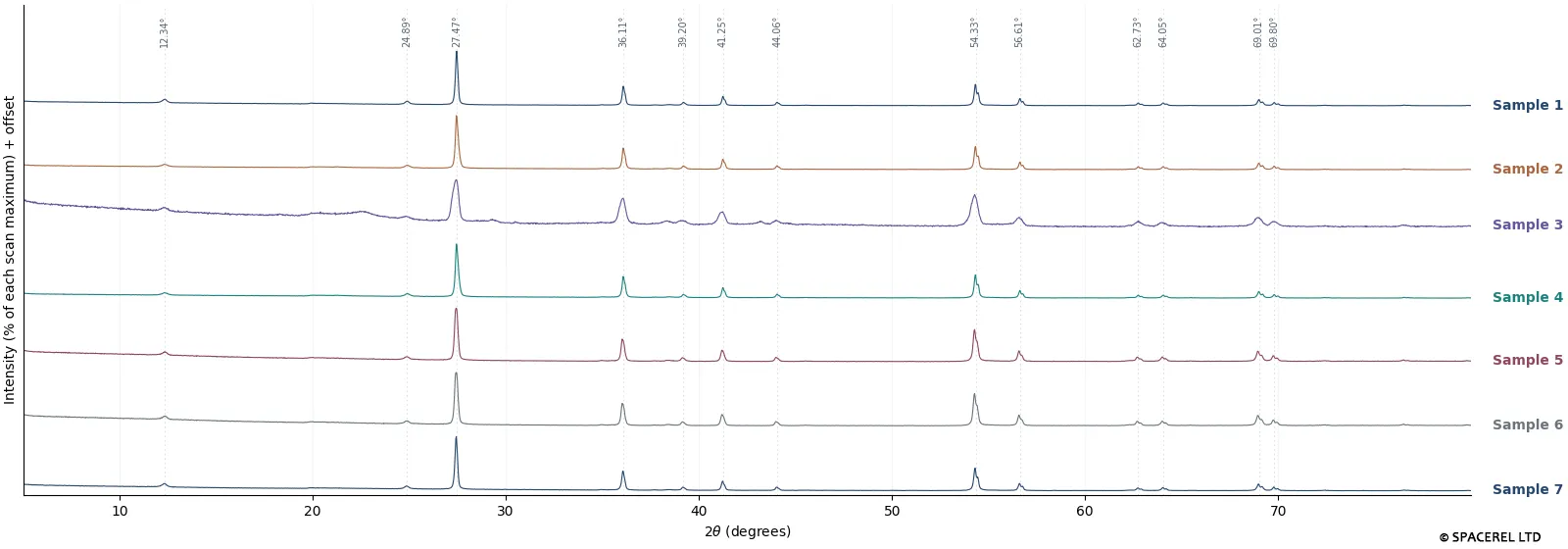
Crystalline Material Analysis
Independent XRD Analysis with Engineering Interpretation
We provide independent X-ray diffraction (XRD) analysis for crystalline phase identification, material comparison and investigation of structural changes associated with manufacturing, processing, degradation or failure.
XRD produces a characteristic diffraction pattern related to the crystalline structure of a material. Analysis of peak positions, intensities and profile characteristics can help identify phases, compare samples and reveal structural differences that may not be apparent from composition alone.
At SPACEREL, the objective is not simply to generate a diffraction pattern. XRD results are interpreted in the context of the engineering problem and, where appropriate, correlated with evidence from techniques such as SEM, EDS and Raman spectroscopy.
What Can XRD Reveal?
XRD is particularly useful where the investigation depends on understanding the crystalline structure or phase composition of a material.
Crystalline phase identification
Identify candidate crystalline phases by comparing measured diffraction patterns with appropriate reference data.
Material comparison
Compare failed, reference, production or differently processed samples for significant structural differences.
Phase transformation
Investigate changes in crystalline phase following thermal exposure, processing, ageing or environmental conditions.
Crystallinity assessment
Examine differences in crystalline character and distinguish sharp crystalline reflections from broader amorphous or poorly crystalline features.
Unexpected phase investigation
Investigate additional or missing diffraction peaks that may indicate secondary phases, reaction products or material changes.
Corrosion and reaction products
Support identification of crystalline oxidation, corrosion or reaction products where sufficient material is available.
Peak and profile changes
Evaluate shifts, broadening or other changes where they may provide useful evidence of structural differences between samples.
Phase Identification and Pattern Matching
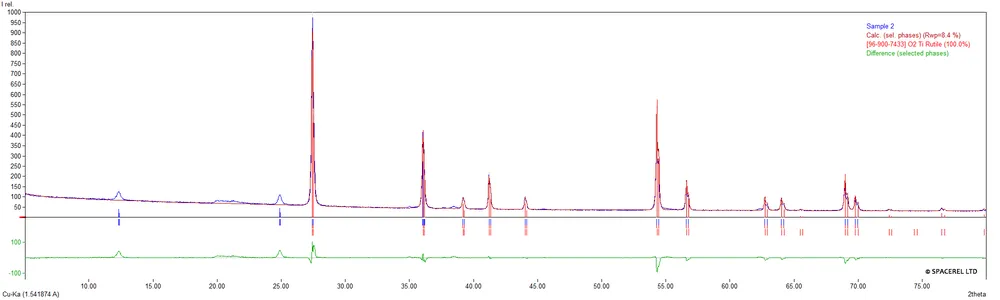
Measured XRD patterns can be compared with calculated or reference diffraction data to evaluate candidate crystalline phases. Agreement in diffraction peak positions and pattern characteristics provides evidence for phase identification, while the difference trace helps assess how well the proposed model represents the measured data. In this example, the measured diffraction pattern is compared with a calculated rutile TiO₂ pattern, demonstrating how XRD data can be used to evaluate crystalline phase identity.
XRD for Failure and Materials Investigation
XRD can provide valuable supporting evidence when a failure or process investigation involves a change in crystalline material structure.
Failed-versus-reference comparison
Determine whether a failed material exhibits a different crystalline phase or diffraction pattern from an unaffected reference.
Thermal exposure and degradation
Investigate phase changes associated with heat treatment, overheating, oxidation or long-term exposure.
Manufacturing and process investigation
Compare materials before and after processing to determine whether an unexpected structural change has occurred.
Deposits and reaction products
Analyse suitable crystalline deposits, corrosion products or residues where sufficient material can be obtained.
Ceramics, oxides and electronic materials
Identify and compare crystalline phases within ceramics, oxides and other engineering materials used in electronic and microelectronic systems.
Combining XRD with SEM and EDS
XRD, SEM and EDS provide complementary information during a materials investigation.
SEM reveals morphology and physical structure. EDS identifies the elements present. XRD can help determine which crystalline phases those elements form.
For example, EDS may establish the presence of titanium and oxygen, while XRD can distinguish between different crystalline titanium oxide phases. Combining these techniques can provide a stronger basis for material identification and failure investigation.
What Engineering Questions Can XRD Help Answer?
What crystalline phase is present?
Measured diffraction patterns can be compared with suitable reference data to identify candidate phases.
Has the material changed after processing or exposure?
Differences between patterns can reveal phase transformations or other structural changes.
Is the failed sample different from the reference material?
Comparative XRD analysis can establish whether a structural material difference accompanies the observed failure.
Is an unexpected crystalline material present?
Additional diffraction peaks can provide evidence of secondary phases or reaction products.
Are different samples or production conditions structurally consistent?
Comparative analysis can identify significant differences between sample groups.
Understanding What XRD Can and Cannot Tell You
XRD provides powerful structural information, but interpretation depends on the material, sample condition and measurement quality.
Important considerations include:
- Sufficient crystalline material must be present for reliable detection
- Minor phases may fall below practical detection limits
- Peak overlap can complicate multiphase analysis
- Amorphous materials generally produce broad features rather than sharp crystalline peaks
- Preferred orientation and sample preparation can influence measured intensities
- XRD provides structural and phase information rather than direct elemental composition
- Pattern matching should be interpreted alongside the wider engineering evidence
Where necessary, complementary analytical techniques can be used to test the interpretation and provide additional evidence.
Our Approach to XRD Investigation
- 01
Define the Engineering Question
Establish what needs to be identified, compared or explained and review the relevant material, process or failure information.
- 02
Review the Sample
Consider the material form, available quantity, expected composition and any preparation requirements.
- 03
Acquire the Diffraction Pattern
Collect diffraction data over an appropriate angular range using conditions suitable for the material and investigation.
- 04
Evaluate the Pattern
Examine peak positions, intensities, profiles, background and significant differences between samples.
- 05
Identify and Compare Phases
Compare measured diffraction information with appropriate reference or calculated patterns where required.
- 06
Correlate the Evidence
Consider the XRD findings alongside available microscopy, elemental analysis, process history and other relevant evidence.
- 07
Report the Findings
Present the observations, interpretation, relevant limitations and recommended next steps clearly.
XRD Evidence for Engineering Decisions
The objective is to translate diffraction data into useful engineering evidence.
Depending on the scope of the investigation, deliverables can include:
- XRD diffraction patterns
- Peak identification and annotation
- Candidate crystalline phase identification
- Reference-pattern comparison
- Failed-versus-reference comparison
- Comparison between sample groups or process conditions
- Identification of significant structural differences
- Engineering interpretation of relevant observations
- Discussion of measurement limitations
- Recommendations for complementary analysis
- Clear technical reporting
Where XRD Analysis Is Most Useful
XRD is particularly valuable for engineering problems involving crystalline materials and changes in material structure.
Semiconductor and Microelectronic Materials
Investigation of crystalline materials, oxides, deposited materials and process-related material changes.
Electronic Materials and Ceramics
Phase identification and comparison of ceramics, oxides and other crystalline materials.
Coatings and Surface Materials
Investigation of crystalline coatings and surface reaction products where material quantity and geometry are suitable.
Manufacturing and Process Investigation
Comparison of material condition before and after processing, heat treatment or other manufacturing operations.
Degradation and Failure Investigation
Identification of phase changes, oxidation products and other crystalline material changes associated with service or environmental exposure.
XRD FAQ
Frequently Asked Questions
What Is XRD Analysis?
X-ray diffraction is an analytical technique used to investigate the crystalline structure of materials. The resulting diffraction pattern can be used to identify and compare crystalline phases.
Can XRD Identify an Unknown Material?
XRD can identify candidate crystalline phases when suitable diffraction data and reference information are available. Complementary analysis may be required for complex mixtures or poorly crystalline materials.
Can XRD Compare Failed and Reference Samples?
Yes. Comparing diffraction patterns can reveal differences in crystalline phases or structural characteristics between failed and unaffected samples.
Can XRD Identify Elements?
XRD is not primarily an elemental analysis technique. Techniques such as EDS identify which elements are present, while XRD provides information about crystalline phases and structure.
Can XRD Analyse Amorphous Materials?
Amorphous materials typically produce broad diffraction features rather than the sharp peaks associated with crystalline phases. XRD can therefore provide information about crystalline and amorphous character, although complementary techniques may be needed for detailed material identification.
Is XRD Destructive?
XRD measurement itself is generally non-destructive, although sample extraction, grinding or other preparation may be required depending on the material and investigation.
Technical References
Further Reading
International Centre for Diffraction Data (ICDD), Powder Diffraction
Overview of powder diffraction, crystalline phase identification, diffraction pattern interpretation and comparison with reference data. ICDD describes phase identification as one of the most widespread applications of powder diffraction.
NIST Inorganic Crystal Structure Database (ICSD)
Reference resource for crystallographic data and identification of crystalline compounds using characteristic diffraction patterns.
Connected expertise