General technical page
Thermogravimetric Analysis (TGA)
Discuss a TGA InvestigationThermal Materials Analysis
Independent TGA Analysis with Engineering Interpretation
SPACEREL provides thermogravimetric analysis (TGA) to investigate thermal stability, mass-loss behaviour and differences between engineering materials.
TGA measures changes in sample mass during a controlled temperature or time programme. The resulting profile provides evidence of volatile release, decomposition and the mass remaining under the selected test conditions.
We interpret these findings against your material, manufacturing or failure question to support material selection, process investigation and engineering decisions.
What Can TGA Reveal?
TGA helps establish how a material’s mass changes during thermal exposure.
Thermal Stability
Compare the temperature ranges over which significant mass changes occur under defined conditions.
Mass-Loss Stages
Quantify individual stages and distinguish a dominant event from smaller changes.
Moisture and Volatile Release
Assess early mass loss that may be associated with moisture, residual solvents or other volatile constituents.
Material Consistency
Compare batches, formulations or supplier materials for differences in thermal behaviour.
Residual Mass
Measure the mass remaining at a defined endpoint to support material comparison and residue assessment.
Comparative Thermal Behaviour
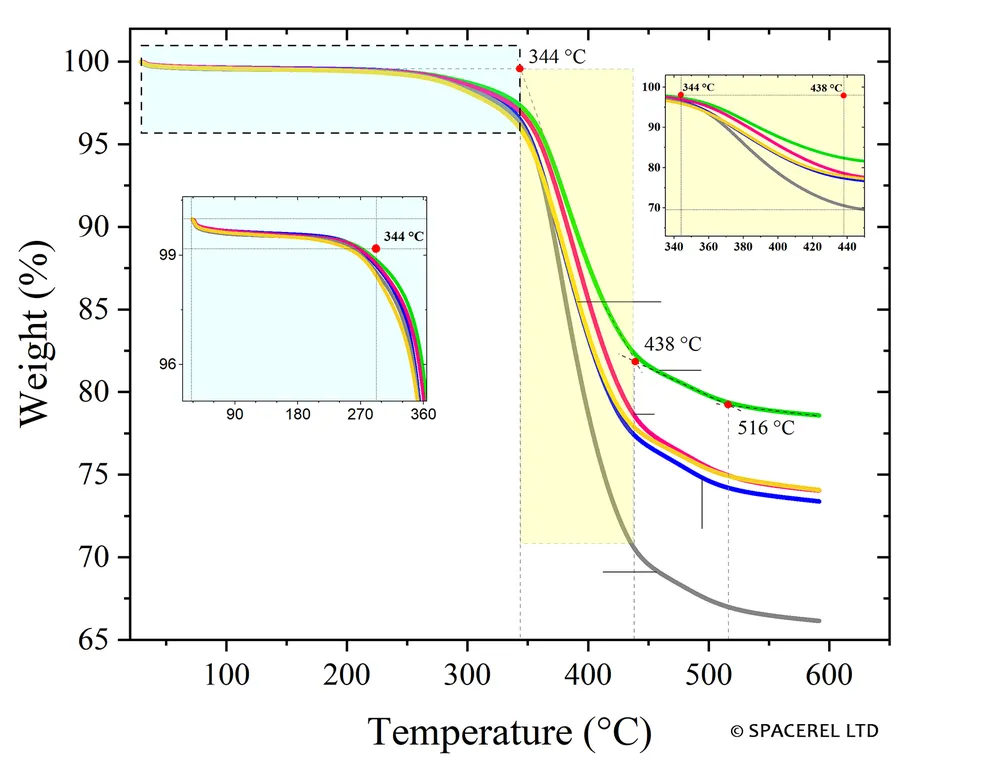
Comparing TGA profiles can reveal differences in mass-loss progression and the amount of material remaining at selected temperatures.
In this example, the curves show different thermal responses across the sample set. Comparing samples under equivalent measurement conditions helps investigate formulation differences, material consistency or changes following processing and exposure.
Resolving Mass-Loss Stages with TGA and DTG
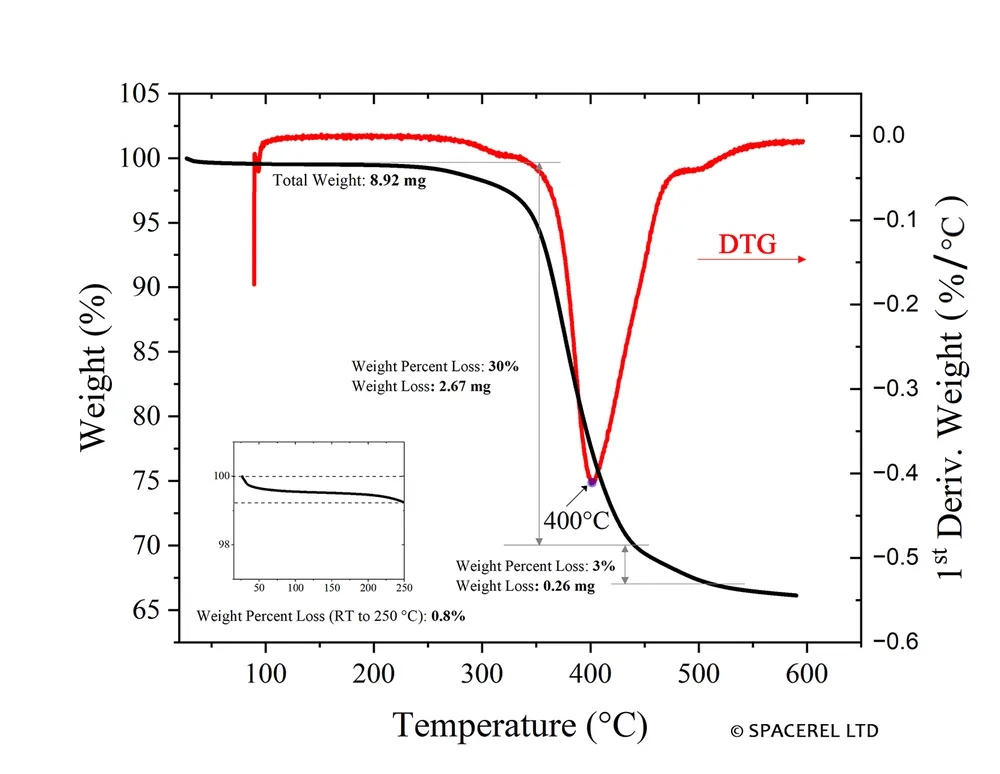
The TGA curve shows the mass remaining, while derivative thermogravimetry (DTG) highlights the rate of mass change. Reviewing both curves helps locate major mass-loss events and distinguish smaller stages.
This example includes a marked DTG peak near 400°C, indicating the temperature of the greatest mass-loss rate during the applied heating programme.
Quantifying Mass Loss and Residual Mass
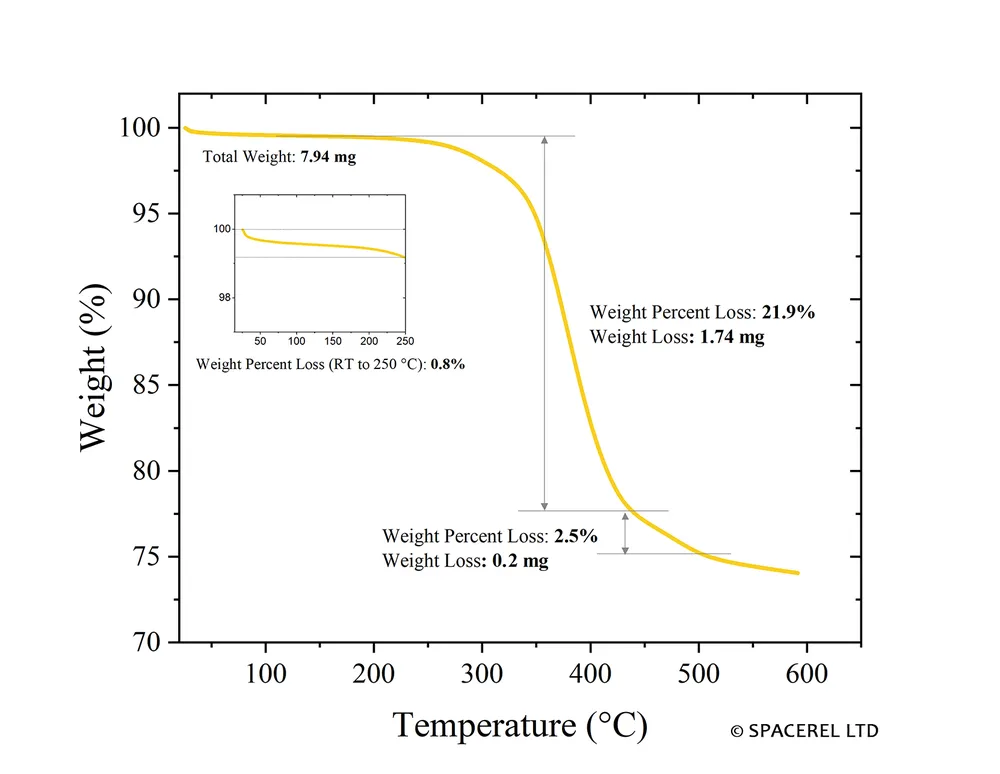
Mass changes can be evaluated over selected temperature intervals and reported as a percentage of the initial sample mass and as an absolute mass change.
This provides a consistent basis for comparing individual stages and the mass remaining at the measurement endpoint. The inset highlights smaller changes within the lower-temperature region.
TGA for Electronics and Materials Investigation
TGA supports investigations where the behaviour of an organic material, formulation or residue may affect product performance.
Adhesives and Bonding Materials
Compare thermal behaviour between adhesive formulations, reference materials and samples recovered during an investigation.
Encapsulants and Potting Compounds
Investigate mass-loss profiles and residual mass to support comparison of polymer-based protection materials.
Failed and Reference Samples
Determine whether a material associated with failure exhibits a different thermal response from an unaffected reference.
Manufacturing and Supplier Changes
Assess whether changes in material supply, formulation or processing are accompanied by differences in thermal behaviour.
Our Approach to TGA Investigation
- 01
Define the Question
Review the material, observed problem and available reference samples to establish what the analysis needs to resolve.
- 02
Select the Measurement Conditions
Define suitable sample preparation, temperature range, heating programme and atmosphere.
- 03
Analyse and Compare
Evaluate mass-loss stages, relevant characteristic temperatures and residual mass. Compare reference samples and review DTG profiles where appropriate.
- 04
Interpret and Report
Relate the findings to the engineering question and provide clear conclusions and recommended next steps.
Evidence for Engineering Decisions
Depending on the investigation scope, your report can include:
- TGA curves and relevant DTG profiles
- Recorded sample details and measurement conditions
- Quantified mass changes over defined temperature intervals
- Relevant onset criteria and DTG peak temperatures
- Residual mass at the specified endpoint
- Comparisons between materials or sample conditions
- Engineering interpretation and recommended next steps
Technical References
Further Reading
General Treatment of the Thermogravimetry of Polymers
Flynn, J. H. and Wall, L. A. (1966).
Foundational research on polymer decomposition, thermal stability and the influence of heating rate on TGA results
Vyazovkin, S. et al. (2014), Thermochimica Acta, 590, 1–23.
Guidance on selecting samples and measurement conditions for reliable thermal analysis, including TGA studies of polymer degradation.